We’re not a boating sort of family. We’ve tested this out several times now and it’s clear that, as a group, we aren’t built for the high seas.
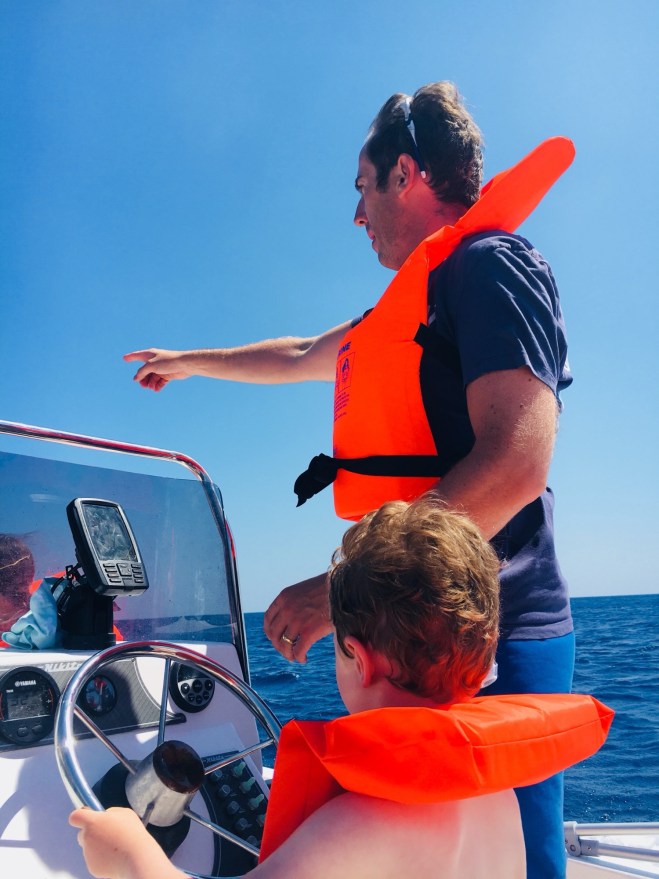
The first time we rented a boat was in Greece in 2018 when Jack fancied a turn around Milos on his own vessel. He chartered a little motor boat and we puttered into the Aegean with only one warning: don’t lose the anchor. Apparently, they are very valuable. The penalty was pretty severe: I can’t remember what but it was something along the lines of walking the plank.
All day long I fretted about the anchor, like it was my fourth child. I would check the rope and ask if it was secure.
Jack grew increasingly ratty with me: ‘No one ever loses the anchor.’ As we set off to return the boat, we lost the anchor.
One of the children misunderstood Jack’s instructions and it plummeted to the seabed. I prayed frantically, whilst ringing the boat people, who whizzed out to us in a swirling sea spray, diving off their speed boat in an impressive rescue effort, like a Greek version of Baywatch.
The kids were delighted- it was the best game ever, having 2 Greek men diving at their beck and call, searching each suggested spot where we might have lost the treasured anchor.
I’ve rarely been so relieved when one of the men sputtered to the surface to tell us he’d located it. We watched in wonder as they disappeared under the water’s surface with a rope, lassoed it, then winched it back onto their boat. Mercifully, we avoided the plank.
Four years passed and we forgot we aren’t seafarers. On holiday in the south of France, Jack fancied himself a skipper again and rented another motor boat. It was all going pretty well until an angry squall blew up out of nowhere and I slid into the belly of the boat under a towel, the kids and I screaming every time we riccocheted off a wave, water crashing over the bow. I swore I would never get back in a motor boat again.
But that was four years ago- the perfect amount of time to forget that we aren’t ocean goers. This time Captain Jack set his sights on a bigger, faster boat that required a license. He studied the ways of the sea, learning the rules and terminology, taking an online test to earn a licence before our holiday.
This time we were in Florida. There seemed a lot more paperwork to sign before they’d release the boat to us. So many scenarios we had to agree to, so many risks we were required to accept. Collisions with other boats, high winds, sudden storms, dehydration, injury from the propeller, jellyfish, sharks, crocodiles.
Who agrees to this? Or who agrees to this if they haven’t got 3 kids excitedly anticipating a day out, choosing their snorkeling gear a few feet away? I would have run away, telling the boat people what I thought about their sea urchins and eels if it didn’t mean disappointing our teenagers.
So I started exploring the risks with a few questions. ‘If we write the boat off, will your insurance cover the damage?’ Maybe I painted too dramatic a possibility. Maybe a smaller amount of theoretical damage would have been a better tack to take. ‘If we scratch the boat gently, just a smidge, what happens?’
The burly, ocean-weathered owner wasn’t impressed with my idea that we might smash his boat up. ‘No,’ he said steadily, staring into my non-seafaring soul, ‘you will be liable. For all the costs.’
‘Don’t you have insurance?’ I pressed.
‘Not for you,’ he said.
‘Will our travel insurance cover us if we damage the boat?’
‘I don’t know- ask your travel insurers,’ he advised testily. ‘We’ll need to run your credit card a second time for the deposit to make sure we have it right.’
‘Why don’t you go and help the kids get some ice?’ Jack said, in a tone that meant, ‘Go away.’
A few minutes later we all met by the dock for various lessons in how not to die on the boat. ‘Always fly your divers-down flag from the boat if you stop to swim so people know you are in the water and don’t mow you down.’ I had this seared into my brain from that point on. Red flag, always fly if swimming.
‘Now I want to see you set off,’ said the owner, who appeared to have no confidence in us as fellow boaters.
‘Could you show me how you’d get it started?’ Jack asked. Wrong thing to say. Possibly worst thing to say.
‘You aren’t giving me much confidence that you’ve ever driven a boat before,’ the old sea dog growled, looking thunderous. ‘You show me how you would start it and I’ll watch.’
‘Right you are,’ Jack said cheerily.
‘He has driven a boat before,’ I said, trying to be helpful, not giving specifics about our earlier experiences. The old salt look unimpressed. ‘You sure?’
‘I am a pilot,’ Jack offered. That inspired no visible assurance. Nor was he remotely interested in Jack‘s online diploma, taken from behind a desk 50 miles inland. He wanted to see his seamanship skills up close, in person. Jack set off, scraping the boat down the entire length of the jetty.
‘Dad,’ the kids yelled, head in hands. I couldn’t watch.
‘They’re all staring at us,’ said one of the kids, looking back at the jetty.
We tried not to distract Captain Jack until our first stop, where we dropped the anchor, carefully, near a shipwreck we’d been told was fun to explore. We tied the divers-down flag to the boat’s T-top and set off, scaring ourselves as we explored the creepy wreckage.
As we climbed back onboard, it was to find the water police pulling up alongside us, a cool uniformed officer in a high speed boat with shades and a gun.
‘You’re not flying your drivers-down flag correctly,’ he stated. ‘It needs to be visible from all around- it can’t hang below the T-top. It needs to be hoisted above.’
‘How do we do that? We weren’t given anything to fly it from- they said to use the T-top.’
‘I am just telling you the regulations. You need to abide by them or I’ll have to fine you,’ he drawled.
‘Could we use a fishing rod?’ I asked.
‘Whatever you got.’
Our eldest son started furiously crafting a flag pole out of our fishing tackle. The officer drove off to crack down on other illegal boating activity.
We tried to drive off too but our anchor had gathered most of Florida’s sargassum into its clutches, smearing the bow in sulphour-stinking seaweed as we tried to lift it and prise it free of vegetation.
Eventually we were off, this time in search of pretty fish. We anchored, flew our flag high, and launched off. Within minutes, the youngest child had lost one of his fins. By the time he told us, a group of pensioners dragging a line of dinghy’s and small inflatables tied together with rope- like a floating wagon train- had parked up over the site of the lost fin.
We tried to hunt around and below this arrangement but it was to no avail. My daughter and I were left in the water for a final look when a boat started bearing down on us.
‘Mum!’ she cried.
We had different approaches to imminently becoming fish bait. I favoured swimming away as frantically as I could, our daughter preferred to wave at the approaching speedsters. Either my thrashing or her shouting averted disaster and we climbed back onboard.
By then the boat had drifted inland and we were perilously close to becoming a shipwreck ourselves.
‘I need you all to get back in the water and pull us deeper,’ Captain Jack directed. So we all jumped into the knee-deep seaweed and started to drag the boat out. We tried to set off again but the same thing happened within minutes.
‘Smells of oil,’ someone shouted helpfully from a passing boat.
We decided the safest option after freeing up the boat a second time was to head further inland and swim safely away from the dangers of the Atlantic. I prayed we hadn’t damaged the boat and that the lost fin wasn’t the owner’s favourite. We had no idea if our travel insurance would pay for any damage. My vague knowledge of holiday cover is that is never covers water activities.
We arrived back at the jetty early. The owner’s face was transformed. He cracked a joyous smile. I realised relief animated his face. The British people were back and his boat wasn’t a write-off. Such was the elation that he told us the lost fin didn’t matter and showed us to the desk to reclaim our full deposit.
My relief topped the old man’s. We’d made it. No one and nothing was damaged, we weren’t in trouble and we didn’t need to test the travel insurance.
Not everyone worries to the extent I do about rules, regulations, insurance, being inside the law and out of bother. But most of us want to be free of worry. Our underlying pursuit is one of peace. We want to know we are safe, that our loved ones are happy, that there’s enough money in the bank, that we have a secure future.
The world often defines peace as an absence of trouble. We each have different ways to access this peace. It might be achieved through living so as to avoid disaster, mitigating its arrival with insurance, savings, knowing the right people, knowledge, power, qualifications.
For some it might look the opposite of my version. It might be adventure- the belief that life can still be exciting, that age isn’t catching up with us. It may be throwing caution to the four winds to test that we aren’t shackled or tethered too tightly. That we can still decide how life goes, we are still in control of our destiny.
Whatever we choose, we are trying to keep at bay disaster, age, boredom, irrelevance, steering life how we want it to go. But it can be an exhausting, transient endeavour. Like us fashioning a flag pole, warding off the incoming speedboat, pulling the boat free. It’s only a short while before the next test presents itself.
This peace is not really peace at all. It can be snatched at any time by an unexpected bill, a diagnosis, a break up, an accident. It’s only available to the extent we can keep the flag flying, shout loud enough, pull hard enough.
In the Bible, peace is much deeper and richer than the absence of conflict. The Old Testament word for peace is shalom, meaning wholeness, completeness, well-being, harmony, flourishing. In the New Testament, the Greek word eirēnē contains the idea of rest, reconciliation, and restored relationships through Christ.
The prophet Isaiah painted a picture of a child who would bring eternal peace:

Seven hundred later, a baby was born in Bethlehem in exact fulfillment of Isaiah’s words, to the praise of angels promising peace:
Jesus spoke of peace more than twenty times in the accounts of his life. Letting these words wash over us gives a glimpse and taste of the peace he offers. According to his words, it’s not the absence of problems:
It’s not the removal of trouble, it’s the freedom from fear, no matter what life throws at us:
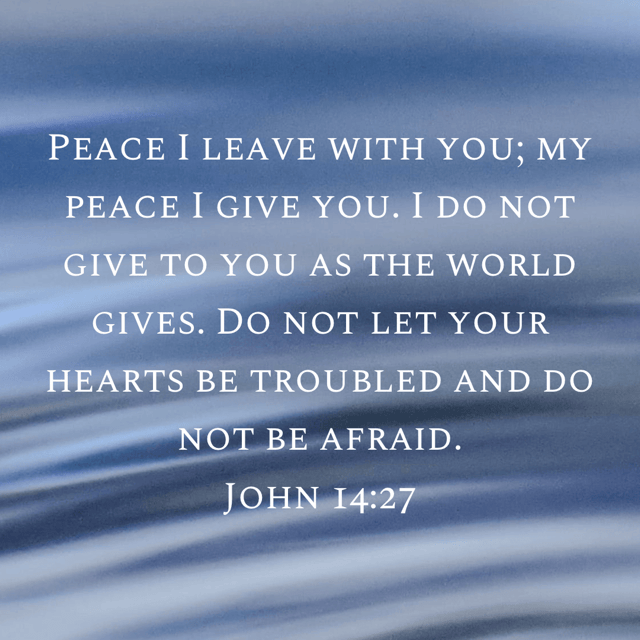
It’s the kind of peace that can reach us deep inside the belly of a boat that’s being tossed about on rough seas. In fact, Jesus demonstrated it from inside a boat during a storm when his friends believed they were going to die. In calming the wind and waves, he demonstrates his power over our chaos, the freedom He secured from our worst fears:
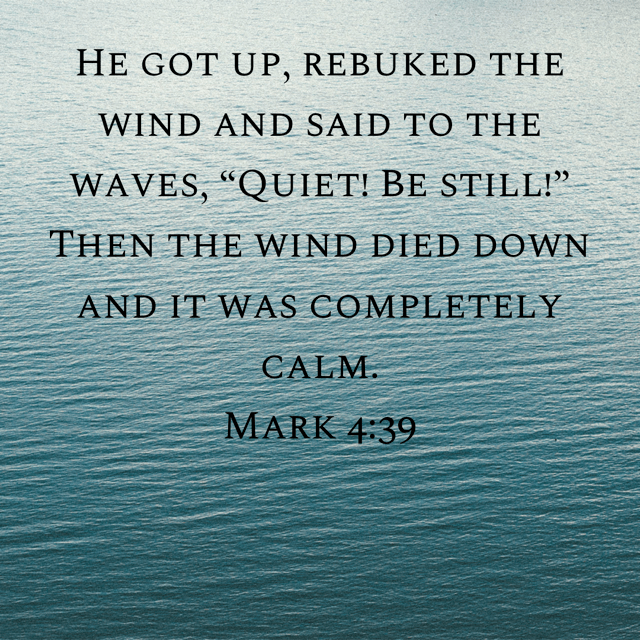
We don’t see much of this peace around us. The world seems to be increasingly devoid of peace- in our conflicts, our climates, our economies. Why would anyone believe Jesus has anything to offer when the peace He promises is hard to spot?
It’s because of the cross. It’s because of what he did when he died and rose for each one of us. His sinless life, his death, and his victory over it means we can experience the peace of living with Him at our side as we face the storms of life.
Each one of is like our little family heading back to shore to check how we measured up. Did we do enough? Will the angry man be placated? Will we scrape through with a small scratch? What happens if we’re a write off- if we’ve totally screwed up? Some of us may know a bit- we’ve done a licence, got a bit of knowledge. Will that help? Some people know nothing- they feel they have no wisdom to offer. They just know their life’s not gone to plan.
Is there a type of insurance that covers the damage? Will there be any conditions, disclaimers, loopholes? Can we trust it?
On our boat trip, my daughter smiled and said ‘Jesus is so cool, isn’t he? He calmed that storm for his friends when they were frightened in their boat and asked for his help.’
She knows He’s got her covered. The assurance He offers isn’t a half -baked insurance policy, it’s not even a decent one- it’s watertight. We can come to Him empty-handed, messed up, confused- in whatever state we find ourselves- and ask Him for help. And He answers.
https://youtu.be/592BE5w8Y7o?is=DR-UY8uxcNMOYYaL
The iconic clip above explains this better than I can- how the man on the cross next to Jesus, dying for his crime, entered paradise with Jesus simply because he asked Jesus to remember him. He’d messed up- he came to Jesus with nothing but a request not to be forgotten. He trusted Jesus was who He said He was.

Wherever we are in life, whatever it’s chucking our way, Jesus is already in the boat with us, waiting for us to cry out. Poised to answer. Ready to quiet our storms and bring us a peace that may not be visible but is real, eternal, guaranteed. Watertight.